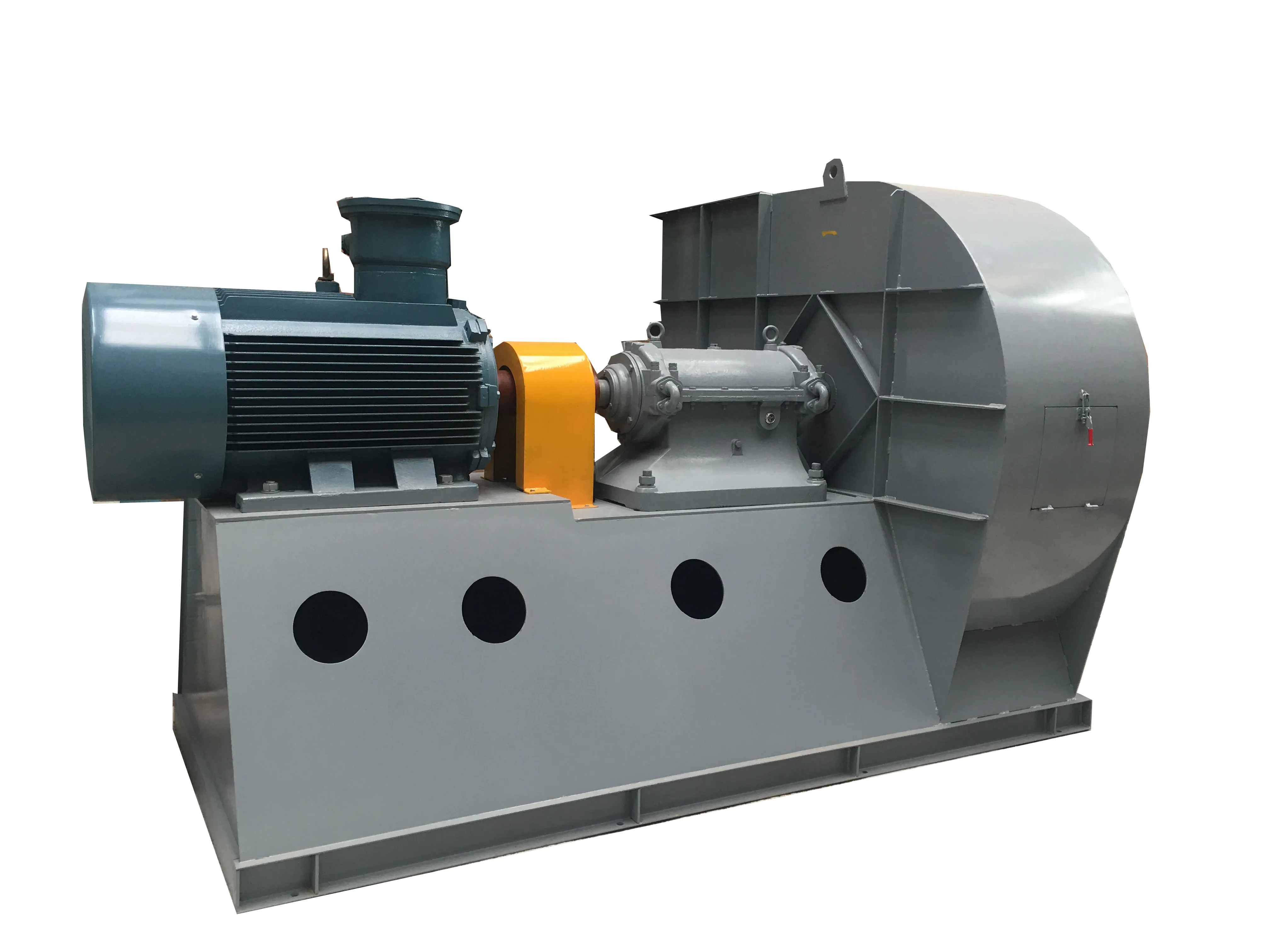
Before a centrifugal fan leaves the factory—or during on-site installation and commissioning—performance testing is a critical step. By accurately measuring air velocity, airflow volume, and air pressure, we can determine whether the fan meets design specifications and ensure that it will operate reliably under real working conditions.
So, how do you correctly measure the air velocity, air volume, and air pressure during centrifugal fan testing?
Yueyu Machinery provides you with a complete step-by-step guide, including testing instruments, methods, and important precautions.
1. Why Must Centrifugal Fans Be Tested for Air Velocity, Air Volume, and Air Pressure?
Performance testing helps to:
- Verify whether the fan meets design and factory specifications
- Evaluate changes caused by installation and ductwork resistance
- Assess system efficiency
- Identify installation or performance issues
- Ensure safe and stable operation under load
For industries such as boiler systems, dust removal, HVAC, environmental protection, and industrial ventilation, fan performance testing is essential.
2. How to Measure the Air Velocity of a Centrifugal Fan
Measuring with an Anemometer (Most Common Method)
Two main types of anemometers are used:
- Vane anemometer (for medium / low air velocities)
- Hot-wire anemometer (for precision low air velocity testing)
Testing Procedure:
- Insert the probe into the outlet of the fan or into a duct test port.
- Measure 6–12 evenly distributed points across the duct section.
- Calculate the average velocity — this is the fan’s actual air velocity.
This is one of the simplest and most effective testing methods.
3. How to Measure Air Volume
Airflow Formula:
Where:
A = Outlet Area (m²)
Q = Air Volume (m³/h)
V = Average Air Velocity (m/s)
(Common Airflow Testing Methods
1. Anemometer + Duct Area (Most Widely Used)
Practical, accurate, and suitable for general ventilation and dust extraction systems.
2. Air Capture Hood (Airflow Hood)
Used for:
- HVAC supply outlets
- Cleanroom ventilation
- Low-velocity measurement
The airflow hood provides direct readings for convenience.
3. Pitot Tube + Differential Pressure Gauge (Professional Method)
Using a Pitot tube & manometer, measure the dynamic pressure and calculate air velocity:V=Cρ2(Pt−Ps)
Where:
- C = Coefficient (≈ 1)
- Pt = Total Pressure
- Ps = Static Pressure
- ρ = Air Density
Ideal for high-velocity and large-volume systems such as boiler induced draft fans.
4. How to Measure Fan Pressure
Fan pressure is typically measured using:
- Differential pressure gauge
- U-tube manometer
- Digital pressure meter
1. Measuring Static Pressure
Procedure:
- Ensure a properly installed static pressure tap.
- Connect the pressure meter.
- Read the static pressure at the test port.
Static pressure determines whether the fan can overcome system resistance.
2. Measuring Total Pressure
Total Pressure = Static Pressure + Dynamic Pressure
Pitot tubes can directly measure total pressure.
3. Measuring Negative Pressure
Induced draft fans often operate under negative pressure:
Read the negative pressure value.
Connect one end of the pressure gauge to the test port.
Leave the other end open to the atmosphere.
📞 Contact Yueyu Machinery
Phone: +86 13246303033
WhatsApp:+1 (408) 590 3985
Email: [email protected] ; [email protected]
Website: [www.yueyublower.com]